
Quick Answer
Stopping Zopiclone suddenly may lead to withdrawal symptoms or a temporary return of sleep difficulties in some people, particularly after prolonged or regular use. However, experiences vary from person to person. Anyone considering stopping prescription sleep medication should seek guidance from their healthcare professional to ensure the safest approach.
In This Guide
In this article, you’ll discover:
- What may happen after stopping Zopiclone
- Why withdrawal symptoms can occur
- What rebound insomnia means
- Common myths and misconceptions
- Practical ways to support healthy sleep
- When to seek medical advice
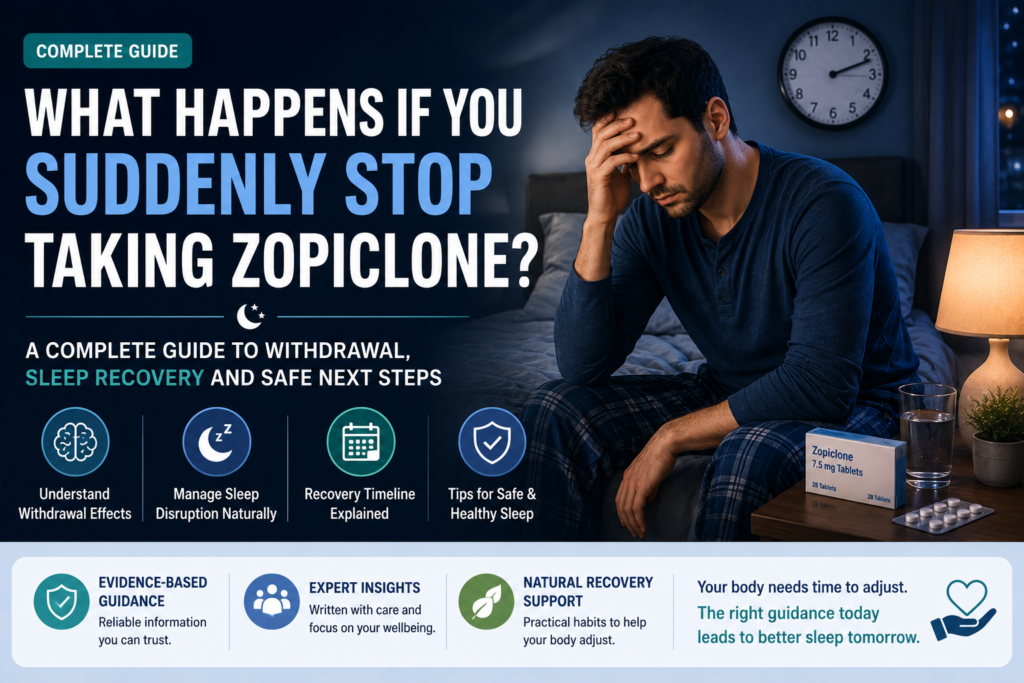
The Morning That Catches Many People by Surprise
Imagine waking up after deciding not to take your usual Zopiclone tablet the night before.
Perhaps you’ve been sleeping well for weeks and feel it’s time to stop.
Or maybe you’ve simply run out of tablets.
At first, everything seems normal.
However, when bedtime arrives the following evening, you notice something familiar returning.
Your mind feels unusually alert.
You keep checking the clock.
Minutes become hours.
The harder you try to fall asleep, the more awake you seem to become.
Many people immediately assume:
“My insomnia is back.”
While that can happen, it isn’t always the full explanation.
Sometimes the body simply needs time to readjust after becoming accustomed to a medication that supports sleep.
Understanding this difference can help reduce unnecessary worry and encourage safer decision-making.
Why People Stop Taking Zopiclone
There are many reasons why someone may decide to stop taking Zopiclone.
Some people experience significant improvement in their sleep and no longer feel they need medication.
Others may wish to reduce their reliance on prescription sleep aids after completing a short course of treatment.
Common reasons include:
- Improved sleep patterns.
- Advice from a healthcare professional.
- Concerns about long-term use.
- Experiencing unwanted side effects.
- Wanting to try non-medication approaches to improve sleep.
Whatever the reason, it’s important to remember that the body often needs time to adapt when a medicine is stopped, especially if it has been taken regularly.
How Does Zopiclone Work?
Before understanding what happens after stopping it, it helps to understand what the medicine actually does.
Zopiclone belongs to a group of medicines commonly referred to as Z-drugs.
Rather than creating “artificial sleep”, it works by enhancing the activity of certain calming signals in the brain.
This helps many people:
- Fall asleep more quickly.
- Wake less frequently during the night.
- Enjoy longer periods of uninterrupted sleep.
Because the medicine influences the brain’s sleep-regulating systems, the body may gradually become accustomed to its presence if it’s used over time.
That is one reason healthcare professionals generally prescribe Zopiclone for short-term treatment of insomnia, alongside improvements in sleep habits whenever appropriate.
What Happens When You Suddenly Stop Taking Zopiclone?
For some people, stopping the medication may not cause noticeable problems.
Others may experience temporary changes while their body adjusts.
These experiences can vary depending on factors such as:
- How long the medication has been used.
- The prescribed dose.
- Individual health factors.
- Other medicines being taken.
- Personal sensitivity to changes in medication.
Because everyone’s situation is different, there is no single withdrawal experience that applies to everyone.
Understanding Withdrawal
The word “withdrawal” often sounds alarming.
In reality, withdrawal simply describes the process of the body adapting after a medication is reduced or stopped.
Not everyone experiences withdrawal symptoms.
For those who do, symptoms can range from mild to more noticeable, depending on individual circumstances.
This is one reason healthcare professionals may recommend gradually reducing certain medications rather than stopping them abruptly.
Any changes to prescription medication should always be made under medical guidance.
Common Symptoms That Some People May Experience
Some individuals report temporary symptoms such as:
- Difficulty falling asleep.
- More frequent waking during the night.
- Feeling restless before bedtime.
- Increased daytime tiredness after a poor night’s sleep.
- Feeling more irritable than usual.
- Difficulty concentrating.
These symptoms do not necessarily occur in everyone, and they can have many possible causes.
If symptoms are severe, persistent or concerning, professional medical advice should be sought promptly.
What Is Rebound Insomnia?
One of the most commonly misunderstood concepts is rebound insomnia.
Rebound insomnia refers to the temporary return of sleep difficulties after stopping certain sleep medications.
This doesn’t necessarily mean your original insomnia has permanently returned.
Instead, sleep problems may briefly feel worse while the body adjusts.
For many people, this effect is temporary.
Understanding rebound insomnia helps explain why patience and healthy sleep habits are often encouraged during the adjustment period.
Did You Know?
Many people who stop Zopiclone successfully continue improving their sleep by combining good sleep hygiene, consistent bedtime routines and guidance from their healthcare professional.
Medication is often just one part of a broader sleep management plan.
Key Takeaways So Far
✔ Stopping Zopiclone affects everyone differently.
✔ Some people notice very few changes, while others experience temporary adjustment symptoms.
✔ Rebound insomnia is usually different from chronic insomnia.
✔ Healthy sleep habits remain important during any recovery period.
✔ Changes to prescription medication should always be discussed with a qualified healthcare professional.
Recovery Looks Different for Everyone
One of the biggest misconceptions about stopping Zopiclone is that everyone follows the same recovery pattern.
In reality, that’s rarely the case.
Some people sleep reasonably well after stopping the medication.
Others notice several restless nights before their sleep gradually improves.
Recovery depends on many individual factors, including:
- How long the medication has been used.
- The prescribed dose.
- Your overall physical and mental health.
- Existing sleep habits.
- Daily stress levels.
- Other medications or medical conditions.
Rather than comparing your experience with someone else’s, it’s more helpful to focus on gradual improvements over time.
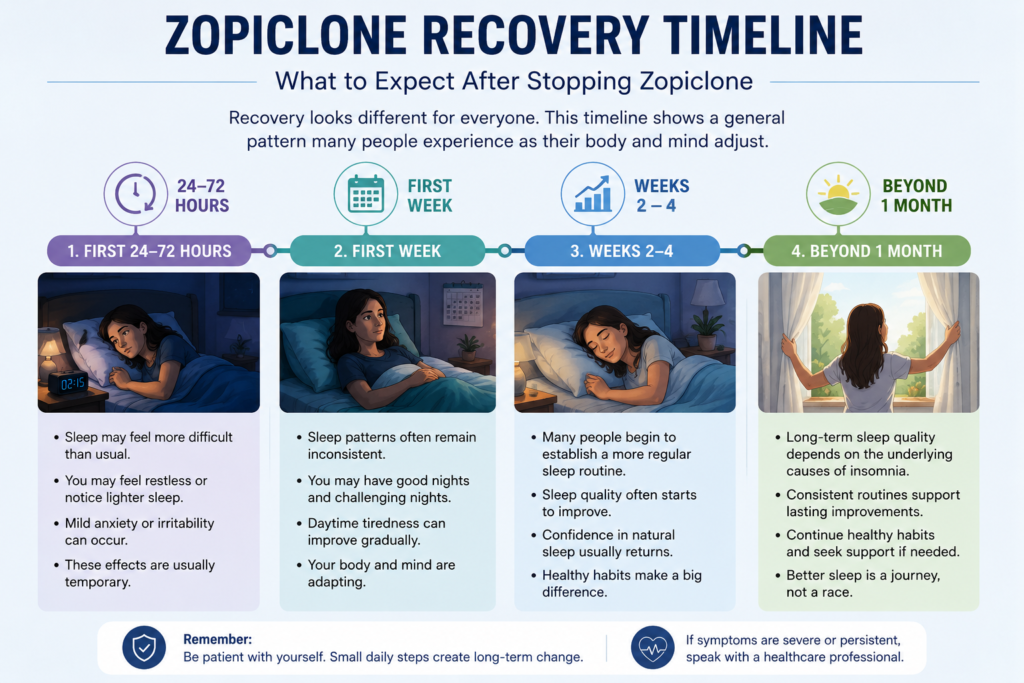
A General Recovery Timeline
While experiences vary, many healthcare professionals describe recovery as a gradual adjustment rather than an overnight change.
| Time Period | What Some People May Experience |
|---|---|
| First 24–72 Hours | Sleep may feel more difficult than usual. Some people notice temporary restlessness or lighter sleep. |
| First Week | Sleep patterns often remain inconsistent while the body adjusts. |
| Weeks 2–4 | Many people begin establishing a more regular sleep routine, particularly when healthy sleep habits are followed. |
| Beyond One Month | Long-term sleep quality depends on the underlying cause of insomnia and ongoing lifestyle habits. |
This timeline is intended as general educational information and should not be viewed as a prediction for every individual.
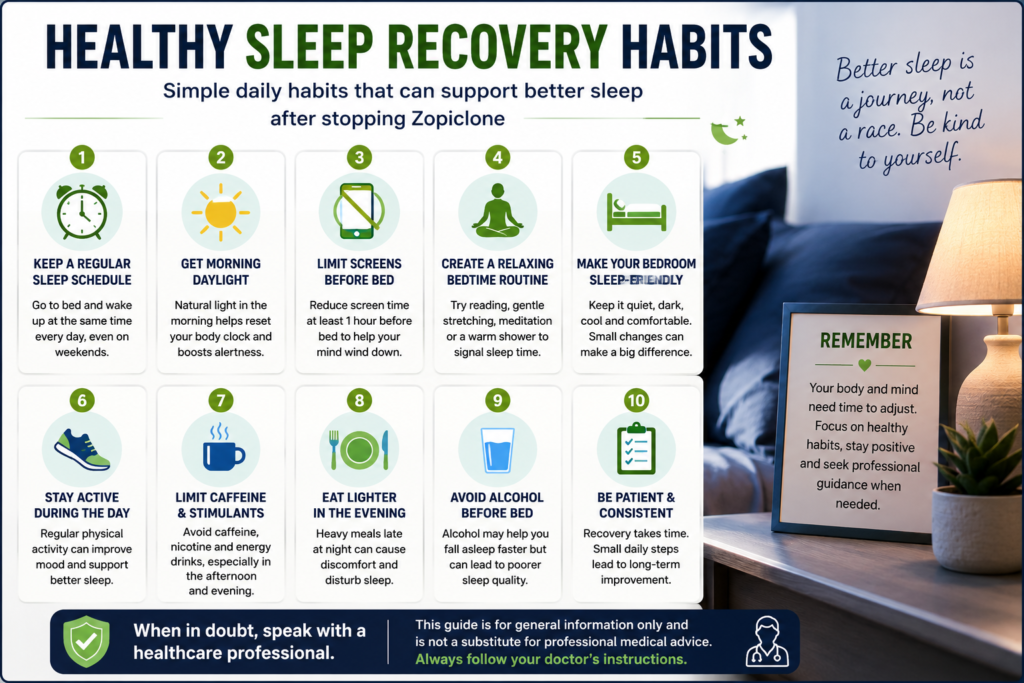
Why Healthy Sleep Habits Become Even More Important
Stopping medication is only one part of improving sleep.
The habits you follow each day often play an equally important role.
Many sleep specialists recommend focusing on routines that support your body’s natural sleep-wake cycle.
These include:
Keep a Regular Sleep Schedule
Going to bed and waking up at the same time each day—even on weekends—helps reinforce your body’s internal clock.
Avoid Watching the Clock
If you repeatedly check the time during the night, anxiety about not sleeping may increase.
Turning the clock away from view can sometimes help reduce unnecessary stress.
Create a Comfortable Sleep Environment
Your bedroom should ideally be:
- Quiet.
- Dark.
- Cool.
- Comfortable.
- Free from unnecessary distractions.
Small environmental improvements can often make a noticeable difference.
Stay Active During the Day
Regular movement supports overall health and may also contribute to better sleep.
Even a daily walk, cycling or light exercise can become part of a healthy sleep routine.
Limit Stimulants Before Bed
Many people sleep better by reducing caffeine, nicotine and heavy meals later in the evening.
Likewise, avoiding excessive alcohol before bedtime may help support healthier sleep quality.
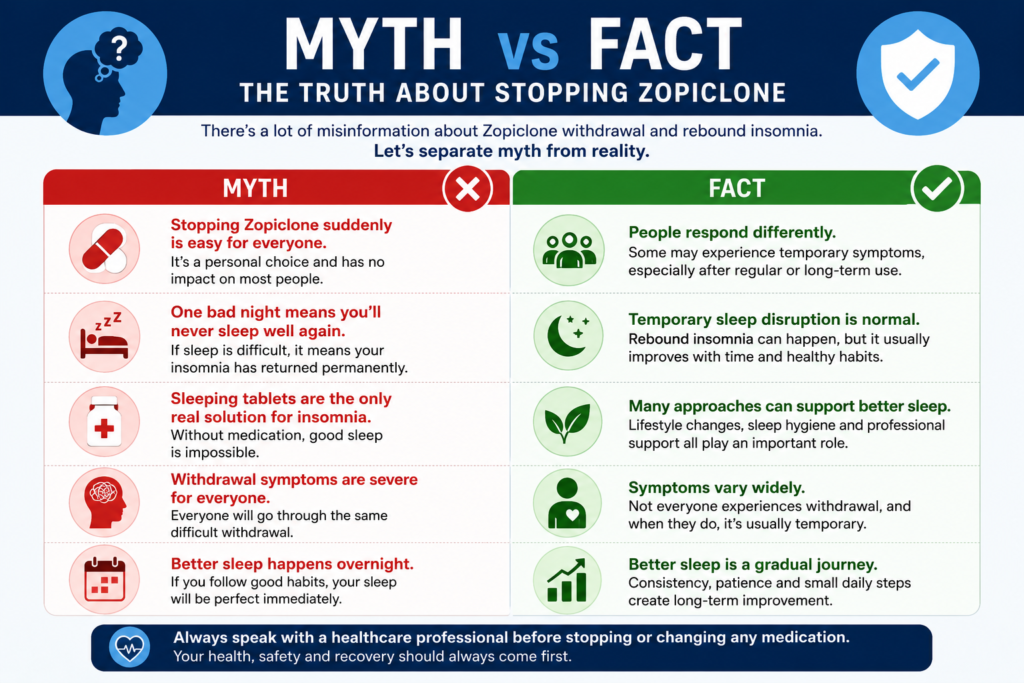
Myth vs Reality
| Myth | Reality |
|---|---|
| Stopping Zopiclone suddenly is easy for everyone. | People’s experiences vary considerably depending on individual circumstances. |
| One bad night means the medication is permanently needed again. | Temporary sleep disruption doesn’t always indicate long-term insomnia. |
| Sleeping tablets are the only answer to insomnia. | Lifestyle improvements and behavioural approaches are often important parts of treatment. |
| Withdrawal affects everyone in exactly the same way. | Individual responses differ depending on many personal factors. |
| Better sleep happens overnight. | Long-term improvement is usually gradual and supported by consistent healthy habits. |
Expert Insight
One of the most encouraging findings in modern sleep medicine is that confidence in your ability to sleep naturally often returns gradually.
Many people become so focused on “trying to sleep” that bedtime itself becomes stressful.
Instead of asking:
“Will I sleep tonight?”
Sleep specialists often encourage a healthier mindset:
“What can I do today to support good sleep tonight?”
This subtle shift helps move attention away from fear and towards healthy daily habits.
Practical Tips During Recovery
If you’re working with your healthcare professional to stop Zopiclone, these simple habits may help support your overall sleep routine:
✔ Keep the same bedtime every night.
✔ Wake up at the same time every morning.
✔ Get natural daylight soon after waking.
✔ Avoid long daytime naps where possible.
✔ Develop a relaxing evening routine.
✔ Keep screens out of the bedroom if practical.
✔ Focus on gradual improvement rather than perfect sleep.
Self-Reflection Checklist
Ask yourself these questions:
- Am I giving my body enough time to adjust?
- Have I maintained a consistent sleep schedule this week?
- Am I worrying about sleep more than usual?
- Have I created a calm bedtime routine?
- Would speaking with a healthcare professional help answer my concerns?
Sometimes simply recognising your current habits is the first step towards improving them.
Key Takeaways So Far
✔ Recovery after stopping Zopiclone is different for everyone.
✔ Temporary sleep disruption does not always mean your original insomnia has returned.
✔ Healthy sleep habits become even more valuable during recovery.
✔ Patience and consistency are often more helpful than expecting immediate results.
✔ Professional guidance is important before making changes to prescription medication.
When Should You Speak to a Healthcare Professional?
Many people experience occasional sleep difficulties at some point in life.
However, if insomnia continues despite healthy sleep habits—or if you’re considering stopping prescription sleep medication—professional guidance is important.
You should consider speaking with a healthcare professional if:
- Sleep problems continue for several weeks.
- You regularly struggle to function during the day because of poor sleep.
- You’re concerned about stopping Zopiclone or reducing your dose.
- You experience symptoms that are severe, persistent or worrying.
- Sleep difficulties begin affecting work, relationships or overall quality of life.
A personalised treatment plan can help identify the underlying cause of insomnia and determine the most appropriate approach for your individual circumstances.
Long-Term Sleep Success Isn’t About One Tablet
One of the biggest lessons from modern sleep medicine is that lasting sleep improvement usually comes from combining several healthy strategies rather than relying on a single solution.
For many people, prescription medication is only one part of treatment.
Long-term success often includes:
- Consistent sleep routines.
- Better stress management.
- Regular physical activity.
- Healthy evening habits.
- Professional support when needed.
- Addressing underlying medical or lifestyle factors.
The goal isn’t simply to sleep well tonight.
The goal is to build healthy sleep patterns that continue for months and years.
Related Sleep Resources
If you found this guide helpful, you may also like:
- Understanding Insomnia: Causes, Symptoms and Treatment Options
- Why Can’t I Sleep? Common Causes of Insomnia
- Sleep Hygiene Explained: 10 Science-Backed Habits for Better Sleep
- Can Insomnia Affect Your Mental Health?
- Can You Build a Tolerance to Zopiclone?
- Zopiclone vs Eszopiclone
- How Long Does Zopiclone Stay in Your System?
These articles work together to provide a broader understanding of sleep health and insomnia management.
Related Sleep Support Products
Where appropriate and following advice from a qualified healthcare professional, readers may wish to learn more about:
- Zopiclone 7.5 mg Tablets
- Zopiclone 25 mg Tablets
- Eszopiclone 1 mg Tablets
- Zopiclone 7.5 mg Tablets
- Browse Our Sleeping Pills Collection
These internal links help readers explore relevant information while strengthening your website’s topical authority.
Final Thoughts
Stopping Zopiclone can feel like an important milestone, particularly for people who have relied on it to manage short-term insomnia.
While some individuals notice temporary changes in their sleep during the adjustment period, others experience very few difficulties.
The important thing to remember is that everyone’s experience is different.
Rather than focusing on one difficult night, look at your overall progress over time.
Healthy routines, realistic expectations and professional guidance can all play an important role in supporting long-term sleep quality.
If you’re considering stopping prescription sleep medication, avoid making changes on your own.
Working alongside a healthcare professional helps ensure that any changes are made safely and appropriately.
Ultimately, better sleep isn’t about finding a quick fix—it’s about building sustainable habits that support both physical and mental well-being for years to come.
Frequently Asked Questions
Can I stop taking Zopiclone suddenly?
Some people may experience temporary sleep disruption or withdrawal symptoms after stopping Zopiclone suddenly, particularly after prolonged use. Always speak with your healthcare professional before changing how you take a prescription medicine.
What is rebound insomnia?
Rebound insomnia is the temporary return or worsening of sleep difficulties after stopping certain sleep medicines. It does not necessarily mean your original insomnia has permanently returned.
How long does it take for sleep to return to normal?
Recovery varies from person to person and depends on factors such as the duration of treatment, dose and individual health. A healthcare professional can provide advice tailored to your situation.
Can healthy sleep habits help after stopping Zopiclone?
Yes. Maintaining a regular sleep schedule, reducing evening screen time, creating a relaxing bedtime routine and managing stress may all support healthier sleep.
Should I speak with my doctor before stopping Zopiclone?
Yes. Prescription medicines should only be stopped or adjusted under the guidance of a qualified healthcare professional.
Medical Disclaimer
This article is intended for educational purposes only and should not replace professional medical advice, diagnosis or treatment. Always consult a qualified healthcare professional before starting, stopping or changing any prescription medication. Individual experiences with insomnia and sleep medicines vary, and treatment should always be tailored to your personal health needs.